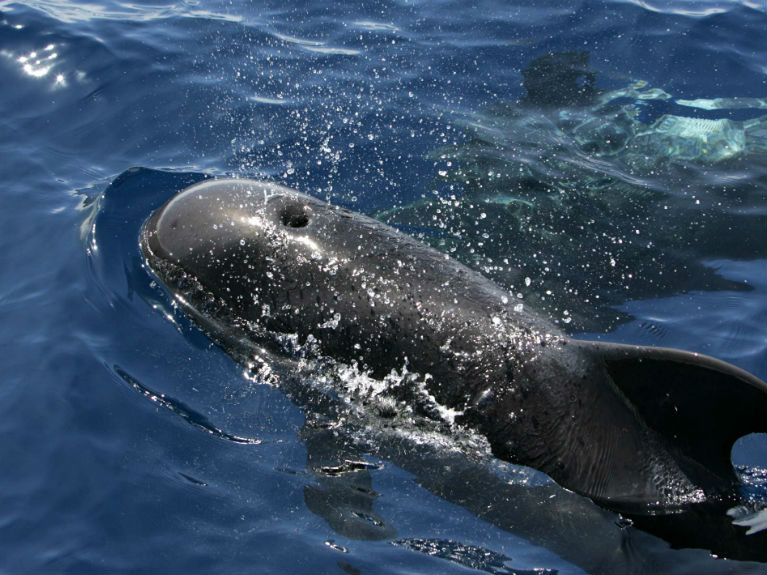
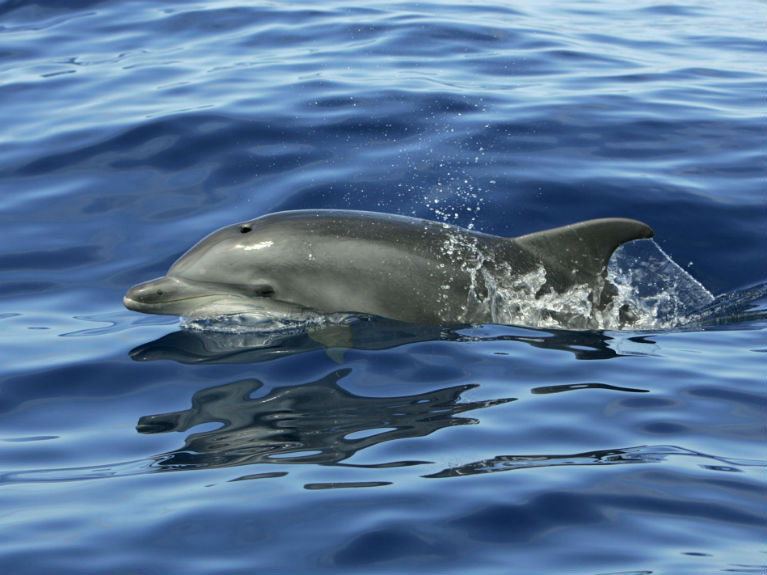
Stumbling through the waves, peeking above the water, playing with the foam, enjoying their freedom, this is how you will see the dolphins and whales of La Gomera.
The transparent waters, warm temperature, and abundance of food have made La Gomera the chosen place as the regular residence of these marine mammals, hence they can be seen almost every day of the year.
More than 20 species of cetaceans can be seen in its waters, almost one third of the species existing worldwide!
The joy of dolphins around the boat infects those who observe them, their closeness and lack of fear are maintained because the sightings are very respectful. The companies that carry out these excursions in La Gomera have the “blue flag,” an authorization that distinguishes them for complying with the current regulations for respectful observation of cetaceans. And almost 100% of the departures can observe specimens of different species.
But… What are cetaceans exactly?
They are marine mammals, so they are not considered fish, they have to breathe outside the water, although some species can stay up to 1 hour in apnea searching for their food at great depths. They are divided into those with teeth (odontocetes) and those with a beard (mysticetes), but the most known division is between dolphins and whales.


They have a sophisticated system to interpret their environment through sound, echolocation. It is very similar to that of bats, they project a sound wave (vibrations or clicks) that impacts with other objects (rocks, fish, boats) and in their rebound (echo) are interpreted by the animal to know the size, distance, etc.
Those with teeth have a varied diet, including fish, shrimp, octopuses, squids, and those with a beard feed through the filtering of large amounts of water through their mouth, retaining small animals, especially small crustaceans (krill).
How can we see them?
There is a varied offer of companies that offer this activity. Most excursions depart from the port of Vueltas (Valle Gran Rey), there are also departures from Playa Santiago and San Sebastián de La Gomera.
In the “Activities” section of the website www.lagomera.travel, you will find all the information and contact details to book your excursion.
La Gomera, being home to several species of cetaceans with a fixed residence, allows their observation almost all year round. Normally, boats do not need to travel long distances from the coast to ensure a sighting. It is common to see species such as the spotted dolphin, common dolphin, striped dolphin, rough-toothed dolphin, rorquals, sperm whales, or pilot whales.

Any advice?
To live this experience, we must equip ourselves properly: wear comfortable clothes and a bathing suit if we want to enjoy the sea, binoculars if we are not prone to seasickness, a cap, sunglasses, and sunscreen. It is also advisable to take some seasickness pills to enjoy the activity without any inconvenience. Some companies offer onboard meals, included in the price.
To capture some good images, it is ideal to wait for the boat to stop or reduce its speed, align the horizon line, observe the position of the sun, and if your camera has the option, choose “sports scenes,” it will allow you to take clear photos in motion.
Is there any regulation?
It is prohibited:
– Swimming with the animals.
– Feeding them.
– Touching them.
– Throwing waste into the water.
– Disturbing them with noise.
Nature, the sea, the sun, free dolphins and whales, combine in an unforgettable experience that will become one of the best memories of your trip to La Gomera.

Valle Gran Rey is a municipality on the island of La Gomera that is about a 60-minute drive from the capital, San Sebastián de La Gomera. If you decide to come to La Gomera by boat, once you leave the port, you come across a roundabout that points the way to Valle Gran Rey, and almost without realizing it, you begin to climb leaving the urban area behind.
The journey begins to surprise you at every turn, at every viewpoint. If you are not in a hurry to arrive, which is advisable to start disconnecting, you can make a stop at the Roques viewpoints, which, like good hosts, welcome you by offering their finest features, surprising you with the stunning views they have reserved for you.
Today we want to tell you about sunsets in Valle Gran Rey, so we will continue our journey to reach this charming place. After entering the Garajonay National Park, about 20 minutes later, you will come across a first deviation that indicates the descent to Valle Gran Rey through the hamlet of Las Hayas, you can also continue about 3 kilometers more and you will find another descent that indicates Arure, another picturesque village before Valle Gran Rey. The roads are very well signposted, so you won’t get lost.


And we’re almost there… After Arure, you continue the descent to the sea, you will pass through two tunnels that as you pass through begin to reveal even more beauty. You will also come across viewpoints that take your breath away, remember we said the journey is for disconnecting, so we recommend you make an almost compulsory stop at the César Manrique Viewpoint, there you will have a panoramic view of the whole imposing valley.
We’re here! The coast of Valle Gran Rey welcomes us with open arms. We hadn’t told you, but the island enjoys microclimates that allow for very pleasant temperatures at any time of the year. The sun guarantees its presence almost every day of the year. And since it is the main character, we will take a front-row seat to watch its farewell show.
Whether you want to sit on a terrace drinking some good local wine or on the edge of the stone that borders the beach or directly on the sand, the show is guaranteed.


Do you want some photography tips to make your photos look better? Here they go:
- Use silhouettes: Objects in front of the sunset will appear black, so you can take advantage of this effect and give personality to the photo by choosing a significant one.
- Incorporate the foreground: You can incorporate some element of the beach and photograph it up close, the sunset will be the ideal frame for that object: a sandcastle, some rocks, a late umbrella, or even the shape of the sand, you will see that you can tell a story with a simple detail.
- Care for the horizon: In addition to being aligned, you must consider what you want to give more interest to, you have to imagine 2 parallel horizontal lines that divide your photo into 3 parts. If you want the sky to be the most important, then place your horizon on the lower line if, on the other hand, you want to give more importance to the land part, the horizon will be aligned with the upper line.
Well, now it’s time to enjoy the color party! The palette already begins to show itself in all its splendor, from yellows to reds in a few minutes, passing through oranges in all their shades.
Every day is different, with clouds or completely clear, with calm seas or with waves, accompanied by the spontaneous sound of drums or simply the sea. But there is something in common, it will never leave you indifferent.

